

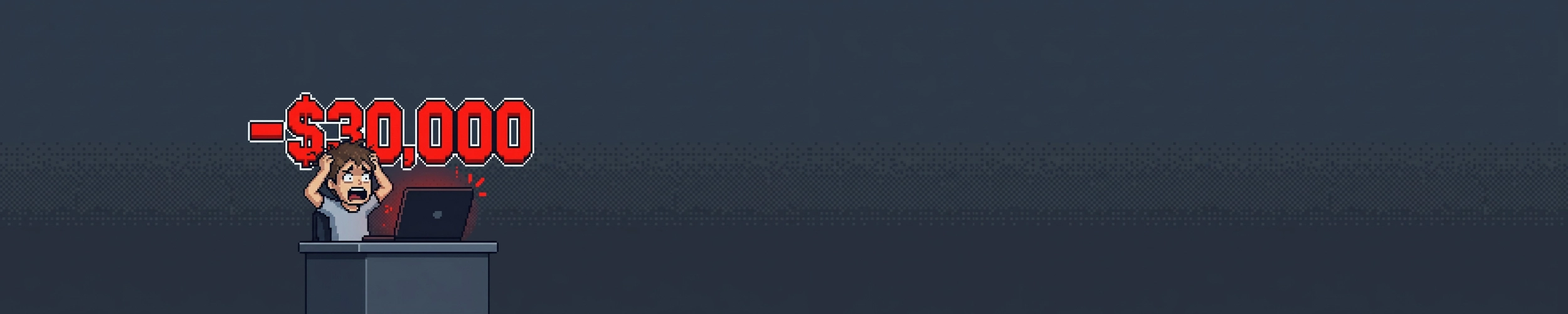
This guy had everything going for him.
20 years of AAA game credits. 65,000 YouTube subscribers. Courses that launched careers.
He dropped cinematic trailers. Released a free 7-hour YouTube tutorial (who does that??). Emailed his list.
Then burned $30,000 in a single week.
The worst part? He probably has no idea it happened.
I watched it happen live. Front row seat. That one stung more than usual because his course helped me land my very first job in game dev. I owe this guy.
But this launch had holes everywhere. A bunch of small “seems fine” choices. Each one looked harmless on its own. Together they torched his revenue.
I kept seeing talented artists go broke. That’s what pulled me into marketing. I had to figure out why the best product doesn’t always win. And it scared me.
Because if a 20-year veteran can lose five figures with the pieces in the wrong order… what is your launch leaking right now?
So I’ll break down exactly where this thing went wrong. And how much each mistake likely cost him.
Because I don’t want this to happen to you.
Teardown:
He had everything and still fumbled it
So there’s this guy. Tim Bergholz.
This ain’t some “I watched two Blender tutorials now buy my Udemy course” pretender. His resume reads like a gamer’s childhood wishlist – Crytek, Ubisoft, Digital Extremes.
You already know the headline: 65,000 subs, the reputation, great product, terrible launch.
Here’s the part you don’t know yet.
Last week he drops a new course. Full AR-15 rifle modelling from scratch. Blender, Substance Painter, Marmoset. The complete AAA pipeline. It’s a beast.
…and it still flopped.
It was one thing: No plan for the selling part.
And look, even grandmasters get wrecked when they wing it. Magnus Carlsen still studies openings. Tim opened Gumroad and hoped for the best. Different sport, same outcome.
So here’s what we’re doing.
I’m gonna walk you through exactly what went wrong. And then I’ll walk you through how he could’ve dodged the bullet.
Buckle up and grab some drink – this ain’t your grandma’s case study.
Timeline
If you want to kill your launch momentum, this is exactly how you do it.
Pay close attention to the dates. That’s where the cracks start.
- 15 Feb 2025 – teaser video hits YouTube.
- …14 months of silence…
- 11 Apr 2026 – an email shows up. “Hey, free chapter dropping tomorrow.”
- 12 Apr 2026 – a mini-course goes live on YouTube. A solid try-before-you-buy move.
- 15 Apr 2026 – big flashy VFX trailer. Email says the full course drops Friday.
- 17 Apr 2026 – course is live. Links are dropped.
Seven days.
Looks clean on paper. Felt different on the receiving end.
I was ready to buy… until I wasn’t
Years ago, Tim’s old 3DS Max course helped me land my first real job in the game industry. So when Tim emails, I pay attention. As a guy who used to model guns just for fun and suddenly remembered why.
I open it.
First email. Free YouTube content. Cool. Watched a bit. Moved on.
Second email? Trailer. Full cinematic VFX. Clean. Polished. Expensive-looking. I watched the whole thing. Thought: “Damn, he put a ton of work into this.”
By the end, my wallet was mentally open. Only one thought in my head: how much?
I scroll the description. Nothing. Check the email. Still nothing.
Come on, Tim.
I was ready and couldn’t find a place to throw my money. The only clue was “Drops this Friday.” So now what? I set a reminder? Pause my life? Whisper to myself “don’t forget” before bed?
Of course I forgot.
Saturday comes. YouTube shows me the trailer again (honestly, MVP move by the algorithm).
I click. Finally find the page.
$99.
And everything… just… deflates.
How? That trailer had me ready to drop $200. Maybe $300. For a second, ULTIMATE version of the career-changing masterclass? Easy.
Then I see “80 hours of content” and that one phrase killed it.
“80 hours of content” sounds like homework. Like one of those 6-hour timelapses with lo-fi beats and zero guidance. Except eight of them, back to back.
That’s two full work weeks. Three seasons of a Netflix show. The entire Lord of the Rings extended trilogy, four times.
Here’s the scariest part: I’m a former student. I trust Tim. I’ve gotten results from his stuff before. I was already emotionally in.
And the launch still talked ME out of buying – what do you think happened to strangers?
The next email made it even worse. We’ll get to that in a minute.
But before we get to that disaster, let me show you what those ‘seems fine’ choices actually cost. In dollars. Because the math on this one is ugly.
The money leaks
This wasn’t one big mistake. That would be too easy. This was a bunch of small “seems fine” decisions stacking up like unpaid bills.
Individually? Whatever. Together? Brutal.
I’m going to walk through each one. What happened. Why it hurts. How it drains revenue while you sleep pretending everything’s fine.
Even if you’ve never launched anything before, you need to see this. These mistakes stay invisible until you know exactly what to look for.
Leak #1: Welcome to the distraction casino
Here’s the best way I can explain it.
Imagine you open a restaurant. Incredible menu. Talented chef. Perfect vibe. But on opening night you don’t tell anyone your address. No. It would be too easy. You leave menus on random food trucks across the city and let people find you.
That’s what it looks like when creators send their audience everywhere instead of their own website.
Tim sent his traffic to Gumroad and ArtStation.
Gumroad takes 10% off the top. Then Stripe takes another 2.9% plus 30 cents per sale. On a $99 course, that’s $13 gone before you touch a dollar. ArtStation takes 8% – slightly better, still a cut.
At 300 sales, you just handed Gumroad nearly $4,000. To process YOUR traffic. Traffic YOU earned. For what exactly? A checkout button?
Tim made the content. He earned the trust. Brought his people. And he paid a 10% tax just to hand them over.
That’s like cooking dinner in your own kitchen and paying a restaurant to eat it. While the restaurant promotes its own specials on your placemat.
But the fees aren’t even the worst part.
Someone clicks your link. They’re interested. Maybe even ready. Where do they land? Marketplace. A distraction casino. They see other creators. Other offers. Other shiny things screaming “buy me instead.”
And even when they buy?
You don’t really “own” that customer. The platform does. They’re Gumroad users who once bought your thing. Gumroad owns the transaction data. ArtStation owns theirs. You get a receipt and a warm feeling.
That’s it.
There’s one more part nobody talks about.
They don’t protect your content either. They hand the buyer a raw download link and wash their hands.
When your product is just a folder of videos, anyone can share it. Anyone can steal it. Your course could be sitting on a torrent site right now and you’d never know. Tim’s appeared 19 days after launch.
We’ll deal with the pirates later. You can’t stop all of them. But you can stop the lazy ones. (And most of them are lazy.)
Your home base should be YOUR website. Your page. Your rules. Marketplaces are fine for finding strangers – let them bring new people and take their cut for that. But your email list? Your YouTube viewers? Your loyal followers? They should always land on YOUR turf. Period.
Leak #2 is sneakier. And it cost Tim more than anything else combined.
Leak #2: The emails… oof
Tim sent three emails.
Which already puts him ahead of 90% of creators (most send zero and then act surprised).
But “sending an email” and “sending a sales email” are two completely different skills. Tim did one. His course needed the other.
And the problems started before he wrote a single word.
He used Gumroad’s built-in email tool. Bless his heart.
Using Gumroad for email marketing is like using a calculator to write poetry. It has buttons. That’s about where the similarities end.
Here is why: Gumroad completely destroys your preview text.
You know that little line of text under your subject line? In your inbox, it shows up as random HTML garbage. It looks like spam. And if it looks like spam, people don’t open it. If people don’t open it, nothing else matters.
Just look how these emails look in the inbox.

(click to enlarge)
That one issue alone kills your open rates. We’re talking 15-20% instead of a healthy 25-40%.
On a list of 5,000 people, that gap is 1,000 extra humans reading your emails. If just 1% of them buy your $99 course, that’s nearly $1,000. Made or lost, depending on whether your preview text looks like a message or a dumpster fire.
Now let’s peek inside each email. Each one was worse than the last.
And the third one has a line in it that made me physically wince.
Email #1: “I made an 80-hour tutorial. Free chapter tomorrow.”
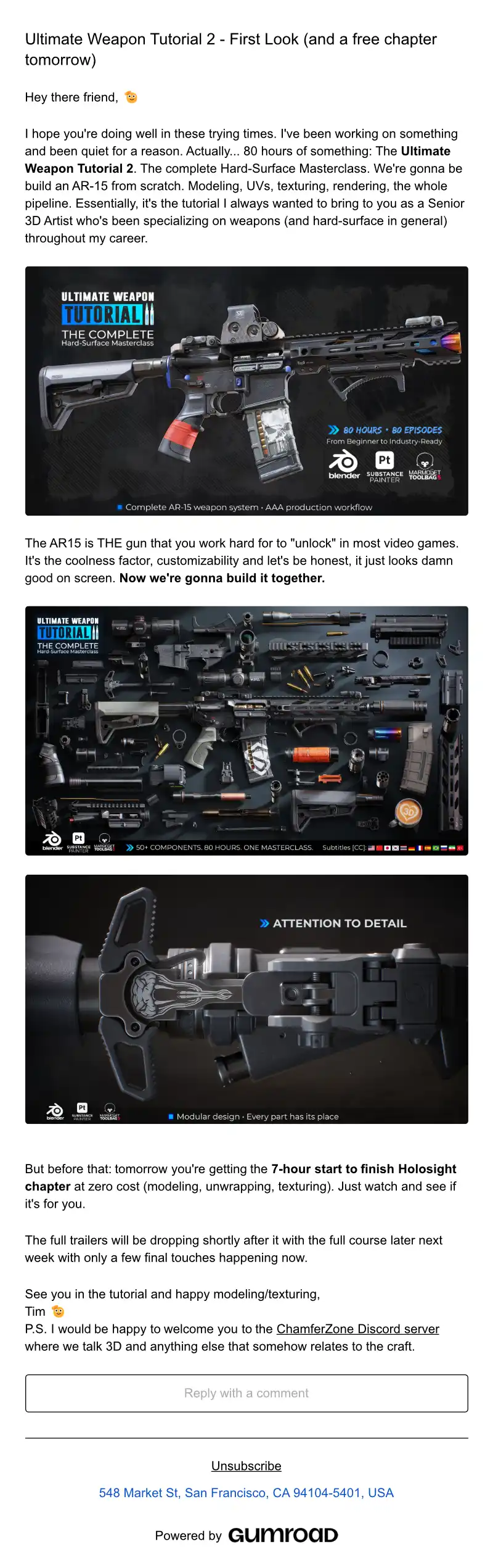
“It’s the tutorial I always wanted to bring to you…”
Cool.
So what?
It’s an announcement. Announcements are dead ends. They state a fact, the reader nods, and the interaction is over.
Your reader is one cat video away from clicking away. I know this because I read it, nodded, and forgot about it the next day. 95% of people do exactly the same thing.
If you drop a free chapter tomorrow, your only job today is to build anticipation. Tell people what’s in it for THEM. Make a promise for something interesting.
Don’t say “I’m dropping a free Holosight chapter tomorrow.”
Say: “Tomorrow I’m dropping a free Holosight chapter that shows you the exact trick to stop fighting Ngons for hours.”
Feel the difference?
One makes you scroll past. The other makes you want to set a reminder.
Announcements get ignored. Promises get clicked.
So promise the goods.
Email #2: “Here’s a trailer. Full course Friday.”
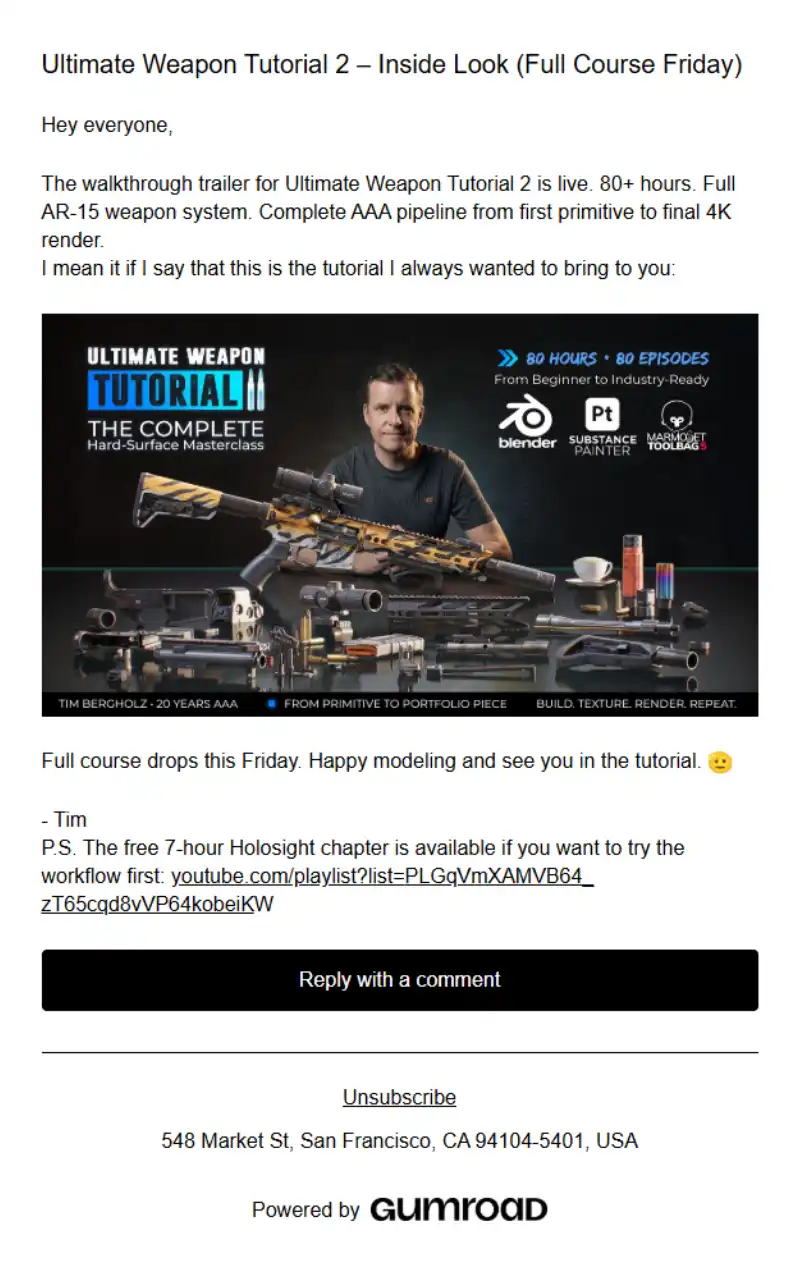
The sequel. Another announcement. Another “please wait.”
I see this mistake ALL the time.
Never tell people to wait.
They will. Then they’ll forget. Then they won’t buy.
Give them a REASON to lean in. Something now. A win. A trick. A tiny “oh that’s useful.” Otherwise you teach them to ignore you.
Here it could be a wireframe screenshot of a complex joint or a material shelf.
Then you drop a quick link to a calendar event. One click, Friday’s locked in, they don’t rely on memory anymore.
That’s how you build a crowd that actually shows up. Takes one minute.
Tim skipped all of that. Trailer, “see you Friday,” done.
And then came the final email. This one was a disaster.
Email #3: “It’s live! Here are the links.”
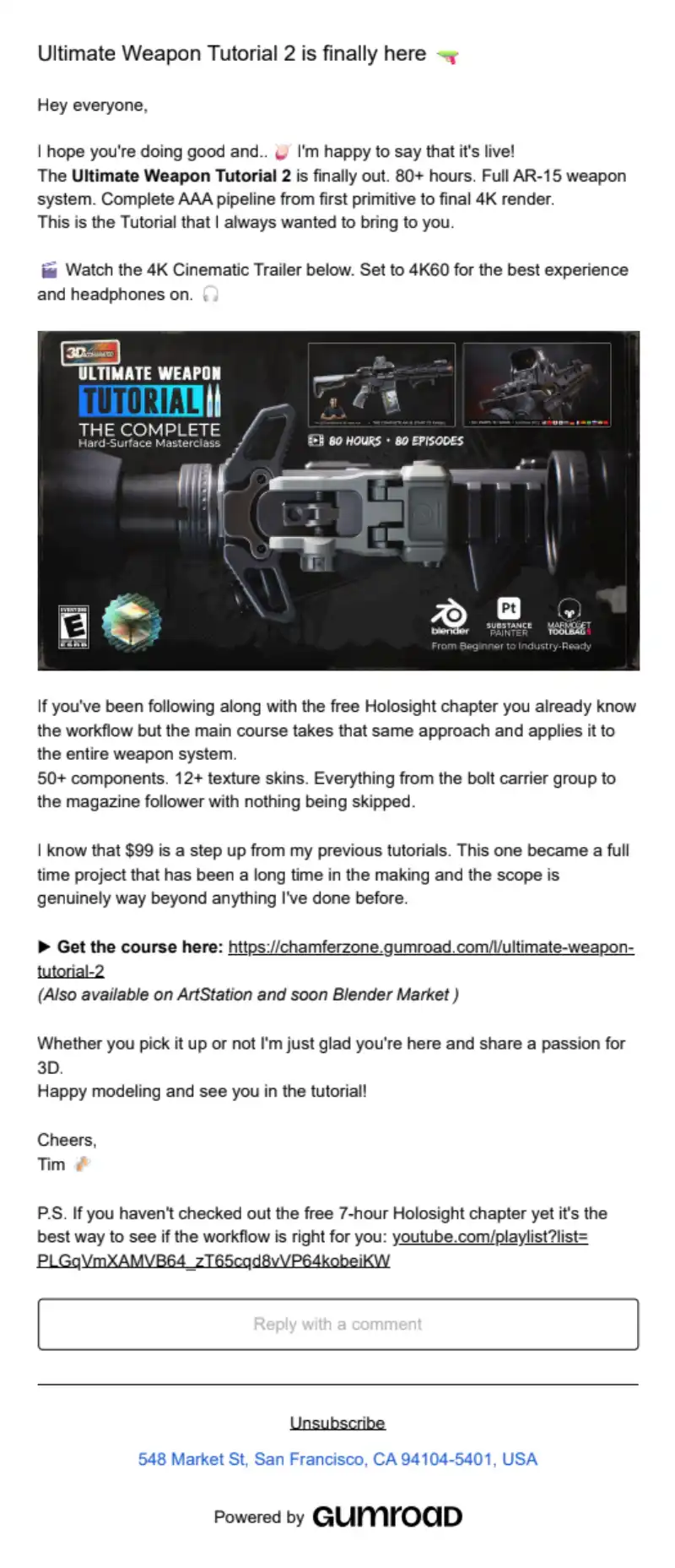
This is the most painful email of all three.
Here Tim made a classic mistake. He gave readers three things to do in one email. Watch the trailer. Grab the course. Check the free chapter.
You know what happens when you give someone three choices? They pick none of them.
Ask anyone who’s ever tried to pick a movie with their partner. Three options is two too many.
And the biggest miss?
Every reader has a scared little voice in their head. It whispers things like:
“Am I good enough?” “Do I have time?” “Will I actually finish this?”
That voice decides the sale.
Tim never talked back. He never said the course works for total beginners. Never showed before-and-after results from past students. Never mentioned you can pick specific sections instead of committing to all 80 hours.
And confused people don’t buy.
Cold emails convert at around 1%. Address those fears and you jump to 4-5%. For every 100 clicks, that’s the difference between $99 and $495 in your pocket.
Just two short paragraphs. That’s all it takes.
(How to answer that scared little voice is exactly what I teach inside The Revenue Letter course. It’s called the Inside-Out method. It works even if you hate writing.)
Tim didn’t know about that.
So he sent three emails. Three missed chances to kill the “maybe later.” And then came one sentence that made it all worse.
Let me show you.
Leak #3: The Weak Offer
This one hurts. Because it’s subtle. Most people don’t even notice they do it.
Right in the middle of Email #3, Tim wrote: “I know that $99 is a step up from my previous tutorials. This one became a full time project…”
No.
No no no.
Stop. Right there. Red flag. Sirens. Someone pull the fire alarm.
You don’t apologize for price. Ever.
Imagine a surgeon saying “I know this is a lot for heart surgery, but I really worked hard on this technique.” You’d run.
The second you say it’s expensive, your buyer agrees with you: “Yeah… you’re right. That is expensive.” You just argued against yourself. And you won.
Meanwhile: it’s 80 hours of instruction from a AAA industry veteran. The production quality rivals $500 courses from Rebelway or The Gnomon Workshop.
$99 is borderline theft.
So why did Tim apologize? Because subconsciously, he knew his offer was weak.
Notice I didn’t say the product is weak. The product is a masterpiece. This course could help someone land a job at a AAA studio. Add a zero to their salary. Change their life.
The offer is a different thing. The offer is how you package your product.
And Tim’s packaging sent one very specific signal. The wrong one.
Sounds great. Felt cheap.
Mathematically, $99 for 80 hours from a legend is a bargain.
But pricing doesn’t work on math. Pricing works on perception. Gut feeling. That split-second “this is premium” or “meh, I’ll think about it.”
Tim set the stage like a Hollywood director. Cinematic shots. VFX compositing. Multiple subtitles. Full production. The kind of quality you see from companies with marketing teams.
I watched it and thought, “Cool. This is gonna hurt my wallet.”
$200? Easy.
$250? Makes sense.
$300? Yeah… I’d complain. Then I’d still get it.
Then I saw $99 and something broke.
Because $99 doesn’t whisper “ULTIMATE MASTERY.” It screams “content bundle.” It definitely doesn’t say “this is THE guy who trained half the industry, pay attention.”
Think about walking into a wine shop. Two bottles. Same grape. One is $12 and one is $45. Nobody grabs the $12 bottle and thinks “ah yes, excellence.” They grab the $45 because their brain says “this one won’t embarrass me.”
(I still buy wine based on how pretty the label looks. But that’s beside the point.)
Price doesn’t just reflect value. It creates it.
Tim poured $300 wine and slapped a $12 sticker on it. And that tiny doubt crept in. “Wait… is this actually elite? Or just… long?”
That one little doubt kills desire dead.
Which forces the creator into a corner where they start…
Selling effort instead of outcomes
Most creators get this backwards. They think buyers care how long something took to make.
They don’t. Not even a little bit.
I repeat. They do. not. care.
Buyers care about one thing: “What does this do for ME?”
You could spend 1,000 hours making something useless. Or 10 hours making something life-changing. Time has nothing to do with value. Outcomes do.
If this course helps someone land a $70k job? $99 is a steal. $299 is a steal. $499 is still a steal. People would pay it smiling.
But that story never got told.
Nobody rolls out of bed and thinks “I want to buy something someone worked really hard on.” They think “I need coffee” and then “I need a badass portfolio piece.” In that order.
This course could be a cheat code for getting an offer from a AAA studio. “Buy this and get hired faster.”
That’s what people wake up wanting.
THAT is what you sell.
Especially when your checkout page has…
No premium tiers, no bonuses, and no exclusives
Tim built a great course. People want it. People buy it. But he gave them one option. One price. One version. Take it or leave it.
But around 15-20% of buyers WANT the premium option. More access. More stuff. Maximum everything. They just need a button to click.
Say we add a $249 “Complete Arsenal” tier. Just 20 people take it. The other 80 stick with $99.
Watch what happens.
20 × $249 = $4,980. 80 × $99 = $7,920. Total = $12,900.
An extra $3,000. For doing almost nothing.
Tim already HAS the bonus content to make this work. Take two weapon skins from the base course. Move them to the premium tier. Done.
Those premium add-ons don’t need to be complicated. A private Discord where you answer questions. A portfolio critique. Access to a student community.
None of that can be pirated. And that matters more than you think.
When your whole offer is downloadable videos, people know those end up on torrent sites. Even loyal customers feel it. It quietly cheapens the whole package.
A live community? A real critique from a real expert? That’s yours alone. Those things feel premium because they ARE premium.
And the final nail in the coffin?
This offer has the urgency of a rock
It’s a big course. Heavy. Not going anywhere. It will be there tomorrow. Next week. Next month. Next year. Zero reason for anyone to buy today.
And guess what happens when there’s no reason to buy today? People don’t buy today. They comment “looks awesome, I’ll grab it later.” Which means they don’t buy at all – because “later” is a graveyard for good intentions.
No deadline = no action. No action = no sales. Not complicated.
(Don’t save this article for later. That would be too ironic.)
Tim could have used launch-week bonuses:
An extra set of texture presets, a reference image library, a “first 100 buyers” badge in the Discord, a dedicated spot in the student work gallery. Something that makes buying THIS week feel different from buying six months from now.
It doesn’t have to be complicated or salesy. It just has to exist.
None of this happened.
The result? Five reviews after the first week. For a course this good, that’s painful.
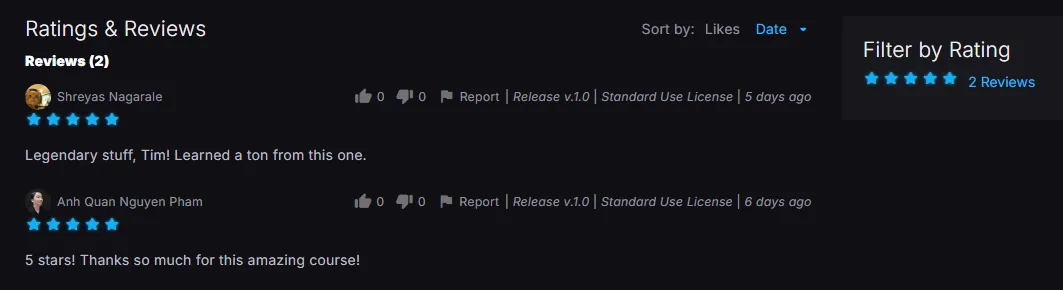
The good news – those reviews are perfect. Five stars across the board. “Legendary stuff.” The product delivered exactly what it promised. The people who bought it are thrilled.
But do five glowing reviews make your wallet happy?
Let’s check the numbers.
The math that hurts
Quick disclaimer: I don’t have Tim’s sales dashboard. These are estimates based on industry conversion and review ratios. The exact figure isn’t the point – the gap between what he made and what he left on the table is.
Conservative numbers only.
One week after launch, the trailer has 7,364 views. Cold YouTube traffic with a “drop a link and pray” strategy converts at roughly 1-1.5%. (how many % buy)
1% of 7,364 views = ~74 sales.
His email list probably added another 20-30 sales. An announcement-style email on a list you haven’t emailed in over a year typically converts at 0.1-0.2%.
Total estimated sales: ~100.
Cross-reference: Tim had 3 reviews on Gumroad and 2 on ArtStation after the first week. About 5% of buyers leave a review. 5 reviews × 20 = 100 sales.
The math aligns, so let’s go with 100.
100 sales × $99 = $9,900 gross.
Subtract platform fees. Gumroad takes about $13.37 per sale (10% + $0.50 + ~3% processing). ArtStation grabs around $8.22 (8% + $0.30). Average it out and Tim’s losing roughly $11 per order.
100 × $11 = $1,100 in fees.
Net revenue: ~$8,800.
Eight. Thousand. Eight. Hundred.
For a full year of work.
Here’s what makes that number sting. His original UWT course has 67 ratings on ArtStation at $39.99. That’s roughly 670-1,340 total sales over its lifetime – and the real number is almost certainly higher.
The sequel should have crushed that in week one. It barely scratched it.
The product was great. The audience was there. The trailer looked like a $300 course.
The packaging, pricing, and positioning didn’t.
Creative people love to ignore that stuff. I get it. Packaging isn’t the fun part. Right up until it costs you five figures and a year of your life.
Good news: this is fixable. And the fix doesn’t require a single new piece of content. Just plumbing.
And it starts with something Tim already owns but never used.
What I’d actually do (step by step)
Here’s exactly what I’d do if Tim came to me tomorrow. Or if you came to me with your course and asked, “How do I not screw this up?”
I wouldn’t touch a single pixel of the art. The product is done. Here’s the plumbing I’d build to make sure it gets paid what it’s worth.
Step 1: Build your home base first
Before you record a single lesson. Before you post anywhere. Before you send a single email. Build your website.
That’s the foundation. Everything else sits on top of it.
By “your own website” I mean five things:
1) A domain name.
Something like chamferzone.com (Tim actually has this) or ultimateweaponcourse.com for the course itself. Domains are cheap ($10-15/year from Namecheap or Cloudflare). So no excuses here.
2) Hosting + a simple site builder.
WordPress works great ($5-15/month on Cloudways or SiteGround). Carrd ($19/year) works too if you just need a single page. Pick one and move on.
3) A checkout tool.
This is literally just the “pay” button. The thing that takes money from your customer’s card and puts it in your bank account. That’s ALL it does.
Gumroad takes 10% of every sale. That’s insane.
ThriveCart costs $495 once. Then you pay nothing ever again – just Stripe’s standard 2.9% + $0.30 per sale. Payhip is even simpler: free plan, 5% + Stripe fees. On a $99 sale, Payhip costs you $8.12 total. Gumroad costs you $13.57.
On 100 sales, that’s nearly $1,000 more in your pocket. The tool pays for itself fast.
I hate subscriptions, so I went with one-time payment tools and the math made sense within the first month. The specific tool matters less than the principle: YOUR checkout, on YOUR site.
4) An email service provider (ESP).
This is where your subscriber list lives. Where you send emails that actually look professional, with proper formatting and preview text that doesn’t look like HTML garbage.
Kit costs $9/month. Sendfox is $49 once for up to 5,000 subscribers. Beehiiv is free up to 2,500. Any of these will do. Just not platform built-in options. Please.
5) A secure video host.
This is the piracy fix I promised earlier.
Stop giving people a folder of raw MP4s. That’s how you end up on torrent sites. Host your videos on Bunny.net or Vimeo. Turn on domain-level privacy and HLS encryption.
It costs pennies per month, but it forces buyers to watch on your site. Casual pirates can’t right-click and download. The dedicated ones will find a way. But dedicated pirates were never going to pay you. They’re not lost revenue – they’re lost cause.
Total cost: somewhere between $30/month and $80/month. Less if you go with one-time payment tools like I did.
Set up your home base first. Then do everything else.
Every YouTube video, every social post, every email points back to one clean sales page on YOUR domain. Other platforms are where people discover the course. Your website is where they buy – and where you own the customer data no platform can take away.
That alone is worth it.
Step 2: Use the trailer to capture emails
Remember February 2025? That’s when the first teaser dropped on YouTube. 14 months BEFORE the course was ready.
No waitlist. No capture page. The video gets views, gets comments… and all that attention evaporates into thin air.
The whole goal of the teaser is to lead somewhere. Without that ‘somewhere’ it’s useless.
Here’s the cold truth about YouTube comments. You can’t email them. You can’t send them a discount code. You can’t remind them you exist six months later. Life moves on.
The fix is embarrassingly simple.
You drop that first teaser. Beautiful VFX. Cinematic. People’s jaws on the floor. Exactly like Tim did – he nailed this part.
Then you put a single link in the video description. One link in the pinned comment. A QR code on the end screen. All of them point to one page on your website:
“Ultimate Weapon Tutorial 2 is coming. Sign up and get the free Holosight chapter before anyone else.”
One page. One form. One button.
Tim has 65,000 subscribers and a trailer people went crazy over. He could have had 3,000 to 5,000 subscribers waiting before the course even launched. People who already raised their hand and said “I want this.”
Instead, those people sit in YouTube comments. You can’t sell to a YouTube comment.
So before your next trailer drops – build the page first. Then drop the trailer.
That order matters more than anything else.
Step 3: Stay Visible During Production
Tim announced his Blender course in February 2025. The next message arrived 14 months later.
Here’s what happens in 14 months of silence: people forget you exist. They found another instructor. They got busy. They moved to a different software.
That warm excitement from the trailer? Gone.
Here’s what I’d do instead.
Once every two to four weeks, send a short update. Nothing fancy. Just a quick note:
- “Finished the unwrapping chapter. Here’s a 30-second peek.”
- “Spent six hours getting one bevel right. Here’s what I learned.”
- “Which skin variant should I cover first? Digital camo or custom decals?”
Each one takes 15 minutes to write. But each one does something powerful – it keeps people interested. It makes them feel part of the process. They want it MORE with every update.
Your email list is a campfire. You don’t need to feed it every day – but leave it alone for a year and you start from cold ash. Tim had to re-introduce himself to people who were already excited. That’s the most expensive kind of waste.
Then when launch day hits, your list thinks “FINALLY” instead of “who is this again?”
Steps 1-3 stop the bleeding. The next two are where the actual money starts.
Step 4: Give away free content – but ask for an email first
Tim released a 7-hour free Holosight chapter on YouTube. Smart move. “Try before you buy” is one of the strongest plays when selling courses.
But he did it backwards. He put the entire thing on YouTube, publicly, with no way to collect their address. Anyone can watch it. Nobody has to give Tim anything in return.
Beautiful for the community. Devastating for the business.
Here’s what I’d do instead.
Put the first Holosight video on YouTube. Full quality, no gates. At the end of that video, in the description, and in the pinned comment: “Want the rest of this chapter? Grab it free here.” Link goes to a page with an email form. Address in, access out.
Your email service sends the remaining videos automatically, one per week. Each one unlocks on YouTube a week later. Your list gets it first. YouTube still works as a discovery channel for new people.
Each of those weekly updates is another chance to remind them about the full product. To share a testimonial. To drop a reminder that the launch is coming. By the time the course goes live, they already half-ready.
That’s the whole point of a freebie – to turn viewers into subscribers and subscribers into buyers. Tim’s version skipped the middle step.
Step 5: Sell to your subscribers first
Before you announce the course publicly, you give your subscribers an exclusive window. 48-72 hours. Just for them.
“UWT2 is ready. You’ve been here since the beginning, so you get first access. For the next 48 hours, the course is yours at $149. After that, the public price goes to $199. This link expires Friday at midnight.”
Then three things happen.
1) You get your first sales immediately.
These people watched the free content. They read your behind-the-scenes updates. They know exactly what’s inside. Many of them buy within hours.
2) You get your first reviews.
Personally message the first 10-20 buyers and ask for a review. Or set it up automatically if you are lazy prefer being efficient.
They haven’t finished the full 80 hours yet. That’s fine. (If they do – check on them. They might not be okay.)
Ask them why they bought, what they expect, and how the first few lessons felt. Those early reviews populate your sales page before the course goes public.
When a new visitor lands on your page and sees “47 students enrolled, 12 five-star reviews” on day one – that’s your best marketing content. For free.
3) You create real urgency.
The 48-hour window isn’t fake. After 48 hours, their subscriber link stops working. This isn’t some sleazy “fake countdown timer” trick. You reward the people who supported you early with a better deal. That’s fair.
About 40% of total launch revenue typically comes from this early window. Warm list, real deadline, first access. That’s the highest-converting moment of your entire release.
At this point, Tim’s already sitting on $37,000 he didn’t have before. And the course hasn’t gone public yet.
Step 6: Public launch with a real deadline
Friday. The course goes live for everyone.
The price is now $199. Your sales page already shows reviews from the early access period. Your trailer is right there on the page. Everything points to ONE page on YOUR website.
You post on YouTube. On your Discord. On your social channels. You send an email to your whole list.
The first week needs to feel different from buying six months later. Include a bonus that disappears after day 7 – an extra texture pack, a Q&A session, access to a private critique channel. Maybe the price goes up by $50 after the window closes.
Something that makes “I’ll grab it later” feel like a bad idea.
During this first week, send an email every day. Each one tackles a different buyer fear:
- Day 1: The course is live. What’s inside, who it’s for, what they’ll be able to do after finishing it.
- Day 2: Results. Student work from the previous course. Screenshots. Reviews from the early access. “Here’s what people are saying after their first 3 hours.”
- Day 3: The biggest objection, head-on. “I don’t have time for 80 hours.” The course is modular. You can pick sections. Even the first chapter alone transforms your workflow.
- Day 4: Frame the price against the result. “$199 for a skill set that pays $65,000-$90,000/year in the game industry.” That’s the only math that matters.
- Day 5: Last call. “The first-week bonus expires tonight at midnight. After that, the course stays available but [bonus] is gone permanently.” This one always gets the highest sales. Always. Because deadlines work.
Five emails. Five days. Each one answers a different version of “why should I buy this right now?”
Step 7: Price it premium
Let’s talk numbers.
Tim priced his course at $99. For 80 hours of premium instruction from a 20-year AAA veteran. That’s $1.24 per hour of instruction.
For context: a private session with a senior game artist runs $50-150/hour. Gnomon costs $54/month. Rebelway charges $800+ per course. Tim’s price positions him below all of them.
Here’s the structure I’d use:
Base tier: $199.
All 80 hours of video. Project files. Subtitles. Still $2.49/hour of professional instruction. Still cheaper than one month of Gnomon. But $199 says “real course” instead of “content dump.”
Complete tier: $349.
Everything in base. Plus an extended reference image library, extra skins, access to a private Discord, and portfolio critique from Tim (async, via Loom video).
The complete tier makes the base tier look affordable by comparison. And it gives the 15-20% of buyers who want maximum.
Early pricing:
Base at $149 for subscribers, $199 for public. Complete at $249 for subscribers, $349 for public.
Platform pricing:
On your own site, the base tier is $199. On Gumroad and ArtStation, list it at $229. Those platforms charge you fees — pass them to the buyer. In every YouTube description and email: “Get the best price at chamferzone.com/uwt2.”
Your traffic goes where you keep the most money. Marketplaces still work as discovery channels. They bring strangers, they take their cut. Your audience lands on your turf.
Absolutely fair.
Step 8: Your evergreen selling machine
Most creators think launch week IS the business. Push hard, make some sales, then nothing until the next project.
That’s the classic info-business playbook where people sell templates they cranked up over a weekend.
Tim’s course isn’t a weekend template. His first UWT lasted 10 years. This one will last just as long. The “one big week and forget about it” approach makes zero sense here.
Here’s how I’d set it up for the long run.
After the first week, take down all the free Holosight videos from YouTube except the very first one. That video stays up permanently – your shop window. The thing that catches new people.
In the description and pinned comment: “Want the full free chapter? All 7 hours? Grab it at [your site].” Someone finds the video. Watches it. Clicks. Enters their email. Gets the free content automatically.
Then your sequence takes over. 5-10 emails that do what Tim’s three should have done: deliver value, build trust, handle the fears, make the pitch. You write it once. It runs on autopilot.
Price the course cheaper through sequence than on the public sales page – $179 instead of $199. That small gap gives people a reason to buy through your emails instead of bookmarking the page and “coming back later.”
(They won’t come back. You know this.)
Tim’s original UWT sold hundreds of copies over years. With this setup, UWT2 could hit that number in months. Every new viewer who finds that first free video enters the same path from “interested” to “paid.” On their own timeline.
Building this kind of setup is a project. If you’d rather skip the wiring – just use my Prime Conversion System. I’ve already built and tested the entire flow – just plug in your links and course info.
But forget my system for a second.
Let’s just run the numbers on what these eight steps would have done for Tim’s launch.
Because the gap is embarrassing.
The math that warms
Let’s run the exact same numbers, but with proper plumbing and a warm list.
The Audience (Feb 2025 – Apr 2026)
The original teaser got 4,875 views. With a waitlist page, a conservative 10% sign up rate gives you ~500 subscribers. Combine that with Tim’s existing list. After cleaning inactive subs, let’s say he has a solid base of 5,000.
For 14 months, he sends regular updates. That list isn’t cold anymore. These people are ready.
Early access period (48 hours, subscribers only).
A warmed-up list with an exclusive early-bird deadline at $149 converts at around 5%.
5% of 5,000 = 250 sales.
250 × $149 = $37,250.
Public release week (5 days).
The launch trailer drops. Same 7,364 views. But this time there’s a real deadline, launch-week bonuses, and daily emails that answer hesitations. Conversion rate doubles from 1% to 2%.
~147 sales × $199 = $29,253.
Total gross: $66,503
Stripe’s fees (2.9%): ~$1,928
Net revenue: ~$64,575.
Compare that to $8,800.
That’s the difference between dropping a link on Gumroad and building a system that sells for you.
That’s without the $349 “Complete Arsenal” tier. If just 20% of those 397 buyers choose premium, that’s another $12,000+.
Even if you cut my estimates in half – smaller list, lower conversion – it still produces $30,000+ more than “drop a link and hope.”
That’s $30,000 left on the table. On the first week alone.
The most uncomfortable takeaway
You can build the best course in history. Shoot cinematic trailers that make people’s jaws drop. Spend a year of your life perfecting every lesson.
And then hand it all to a system that can’t do it justice.
At $8,800, Tim earned roughly $1.10 per hour of work he put into this course. That’s below minimum wage in every country I’ve checked. Including the ones I wouldn’t want to live in.
That’s the expensive part. The content is done. The skill is done. The hard part is behind you. The plumbing is the easy part – it just needs to exist.
If you have a course that deserves better than “post and pray,” everything in this article is free to use. Build your home base. Capture their addresses early. Don’t go silent. Price with confidence. Create a deadline. Automate your sales emails.
That’s the whole playbook.
But if you’d rather have someone build the system for you – I do that too.
Most of my work is email stuff for businesses. Big budgets, long timelines, analytics. Creator launches are the opposite. No bureaucracy, fast execution, and the revenue difference shows up in the first week.
So if you have a premium course launching soon and you’d rather not leave five figures on the table:
Email me at contact@sparkthe.click with “Course Launch Help” in the subject. Tell me what you’ve got, where you are, and what your list looks like. I’ll tell you exactly where the leaks are and what to fix first.
P.S. If I had a landing page for this I’d have to contradict half my own article. I’ve done dumber things, but not today.