


Email marketing supposedly delivers $42 for every $1 spent in 2026.
Cool story.
Because if that’s true… why does your inbox look like a landfill sponsored by “Weekly Newsletter #47” and “Quick question” from someone who absolutely does not have a quick question.
Go check your own inbox right now. How many business emails made you want to click?
Not “fine, I’ll click because I’m bored.” I mean “oh that’s interesting!” want.
Not many, right?
So if the average ROI is $42…. and the average business email sucks… something doesn’t add up.
Here’s what’s actually happening: most business emails are complete garbage. But a small group of businesses is doing email so well that they’re dragging up the entire industry average.
While most companies send random newsletters hoping something sticks, these operators have built systems that work. Not sometimes. Every time.
They’re not just beating the average – they dunk on it.
And no, it’s not just because they hire better writers. (They do.)
The difference is they stopped treating email like a creative writing and treat it like business infrastructure.
The mistake? Treating email like a creative problem instead of an engineering one.
The Senior Marketer Trap
Here’s the pattern: entrepreneurs treat email like a word puzzle.
“If we just find the right subject line…” “If we just nail the perfect hook…” “If we just hire that copywriter everyone’s using…”
So they go on a talent hunt. They stalk LinkedIn. They poach from competitors. They finally land that hotshot writer charging $3-5k/month.
And it works! Opens go up. Clicks go up. Revenue goes up.
Then life happens.
The writer quits. Or gets poached by a bigger client. Or has a baby and goes part-time. Or decides they’re really meant to be a novelist and moves to Vermont to “find themselves.” Whatever.
And suddenly you’re back to square one because all that “expertise” just walked out the door.
Bus Factor = 1. (system breaks if 1 person gets hit by a bus)
Because talent is a rental. Systems are assets you own.
The businesses crushing it with email aren’t hiring Don Draper clones. They’re running tight, reproducible systems that work regardless of who hits send.
Think about aviation.
You don’t want someone strutting into the cockpit like, “Today I’m feeling inspired. Let’s freestyle the landing.”
You want a pilot who follows the Pre-Flight Checklist. Not because they forgot how to fly, but because human memory is a liar. It gets cocky. It gets tired. It skips steps.
Even Captain Sully relied on protocols when he landed on the Hudson, not vibes.
If airlines ran like most marketing departments, planes would be falling out of the sky because the pilot “wasn’t in the mood” to check the landing gear or decided to “A/B test” the fuel levels mid-flight.
Aviation is safe because it’s built on redundancy and checklists while most marketing is a disaster because it’s built on ego and vibes.
So what’s actually broken?
Most small businesses run email like this:
Someone (you, your marketing manager, your VA, your cousin who likes writing) sits down once a week and tries to pull an email out of thin air.
No distinction between “this person just signed up yesterday” and “this person bought from us six months ago.” No separation between “here’s your receipt” and “here’s why you should buy again.”
It’s all just… emails. Sent with hope. Powered by vibes.
That’s the problem. Because different pipelines do different jobs.
Running them all with one logic is like trying to build a house using only a hammer. Sure, you can hammer in a screw. But don’t be surprised when things fall apart.
So what’s the alternative?
The Four-Pipeline Framework
A real email system recognizes you’re running four separate pipelines and each one plays by different rules.
Think of it like this: you wouldn’t use the same process to onboard a new employee, run a board meeting, handle customer support, and do payroll. Each has different objectives and different protocols.
Email works the same way.
Pipeline #1: New lead onboarding
This is your automated welcome sequence. Its job isn’t to extract money immediately (even though plenty of businesses try and it’s… a choice).
Its job is indoctrination.
You teach people how your world works. What to expect. Why trusting you was smart. You lock in confidence.
Usually brands send one “thanks for subscribing” email and then vanish. Or they immediately try to sell you their “Platinum Elite Supreme Package for just $5,000!”
Bad move.
Think about it: someone just gave you permission to message them. They’re in the honeymoon phase. This is your chance to build a relationship that leads to the first sale
But instead of capitalizing on that moment, people waste it with generic confirmations.
Pipeline #2: Regular Broadcasts
These are your manual, timely emails. The ones you actually write when you have something to say.
Launch? Broadcast.
Seasonal promo? Broadcast.
Industry insight? Broadcast.
This is where most businesses think all email marketing lives. It doesn’t. It’s just one piece of the puzzle.
And even these should run on a documented structure. Not a rigid template, but a repeatable process. Because reinventing the wheel every Tuesday makes you tired and broke.
Which leads to the most profitable pipeline…
Pipeline #3: Ascension Engine
Here’s the fatal engineering error: someone buys and got dumped right back into the general “Broadcast” bucket.
This is financial suicide.
A stranger who signed up for your newsletter and a customer who paid you $500 are two completely different people. They have different psychology, different trust levels, and different needs.
Yet businesses send both the same “Check out our latest products!” message.
That’s like treating your spouse and a stranger at a bus stop the same way. ((let me know how sleeping on the couch feels)
Ascension is your automated system for the second sale.
Here’s how it works: Someone buys Product A. The system moves them into an ascension sequence. After they’ve had time to get results, it offers the logical next step. Premium package. Upgrade. Complementary product.
You increase LTV without playing “What should we send this week?” roulette.
Economics don’t lie:
- Cold lead to first purchase: 1-3% conversions
- Happy customer to second purchase: 20-40%
Most businesses obsess over the hard game (getting strangers to buy) and completely ignore the easy one (getting customers to buy again).
I will never understand this. It’s like stepping over a $100 bill to chase a penny that’s rolling downhill.
Pipeline #4: Transactional Layer
Receipts. Shipping notices. Password resets. Account updates.
The boring utility stuff. The vegetables of email marketing. Necessary but unsexy.
Except these emails get opened like crazy because people want them.
Newsletter with a clever subject line? 20% open rate.
Password reset email? 94% open rate.
And businesses waste those opens on “Here is your receipt. Goodbye forever.”
Add just one strategic line (“P.S. Customers who bought X also love Y”) and generate 8-12% of monthly revenue from what used to be throwaway messages.
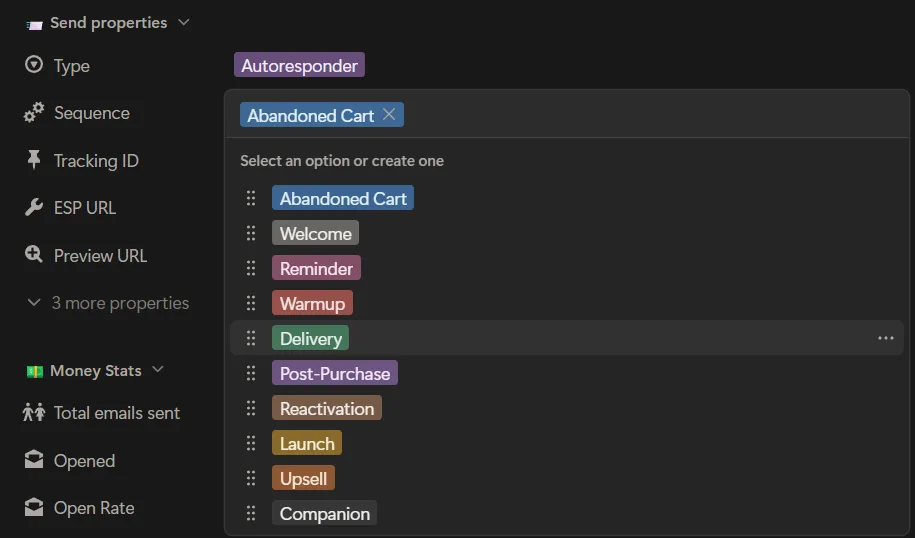
This isn’t just theory. Here’s how I separate these pipelines in my databases so I never accidentally send a broadcast when I should be running a retention trigger:
Structural Triggers > Emotional Triggers
Copywriters love talking about emotional triggers. “Create urgency!” “Tap into pain points!” “Tell a story!”
Fine. But that’s not what actually gets clicks – structural triggers do.
Things like:
- How your preview text works with your subject line (most businesses ignore preview text completely, which is like having a billboard but only painting half of it)
- Whether you lead with the benefit or the mechanism (different products need different approaches)
- If you’re opening a loop or closing one (affects whether people keep reading)
- Where your CTA sits in the email (too early kills the flow, too late loses attention)
- Image placement relative to your primary link (visuals can sabotage your clicks)
- Whether your PS reinforces the main offer or introduces a secondary angle
These aren’t creative decisions – they’re engineering decisions.
You test them once, document what works, and replicate it forever.
And still, marketers treat every email like a fresh creative project and forget everything they learned last Tuesday. “What should we say this week? How should we structure it?”
Amnesia? No idea.
The businesses who’re crushing it answered those questions once, three years ago. Now they just plug content into the same structure and it spits results on repeat.
That’s the difference between hoping and knowing.
Why “better copy” isn’t the (only) answer
Good copy matters. Absolutely.
Good copy is premium gasoline. Fancy packaging. Smells expensive. Great at racing track.
But if you pour it into a lawnmower you still don’t go 80mph on the highway. You just spend more money while making engine noises with your mouth.
Here’s what I’ve seen over and over:
Decent copy inside a good system beats great copy inside a broken process. Every time.
Because systems replicate while talent doesn’t.
Your marketing manager quits. System keeps running.
Copywriter takes leave. System keeps running.
You take a vacation. System keeps running.
But if you’re dependent on creative geniuses who can “nail” every email? You’re one resignation away from a revenue cliff.
Most small businesses approach email backwards.
They think: “We need better emails → Let’s hire a better writer → Hope their copy works → Repeat when they quit or disappoint.”
Winners flip it: “We need better results → Let’s build a better system → Plug in competent people → Get predictable outcomes.”
It’s the difference between renting talent and owning infrastructure.
One scales. The other doesn’t.
So Here’s the Question
Are you building a business that works without you?
Or are you trying to out-write every problem, week after week, hoping the next email finally hits?
Because you can’t rent your way to sustainable growth.
Writers quit. Creative geniuses get tired. Inspiration flakes.
A system doesn’t care. It works Monday through Friday, rain or shine, motivated or not.
So if you’re tired of email roulette and ready to build infrastructure that actually works, I’ve packaged my exact system into Bulletproof Broadcasts.
It’s the protocols, templates, and logic straight from my agency workflow.
You get:
- proven email architectures (not scripts. structures)
- trigger logic for automations
- pipeline protocols (what goes where and why)
- quality checklists (non-negotiables before you hit send)
Any competent person plugs into this and produces emails that convert. Not because they’re a genius – because the system does most of the heavy lifting.
That 42:1+ ROI isn’t magic. It’s just what happens when you build the machine that lets good copy work.
System first. Words second.
P.S. Bus Factor = 1 is fine if you’re a solopreneur or food blogger. Less fine if you’re running a business and trying to scale.